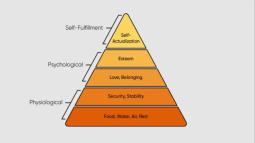



Maslow's hierarchy indicates that human needs can be arranged hierarchically, with basic needs at the bottom and psychological and other higher-level needs at the top.
Satisfying each level of need is crucial to progress toward self-actualization and realizing one's full potential. This article discusses Maslow's theory of human needs.
What is Maslow's Hierarchy?
Maslow's Hierarchy—or Maslow's Hierarchy of Needs—is a psychological theory proposed by Abraham Maslow in his 1943 research paper, A Theory of Human Motivation. This hierarchy is systematically arranged, commencing with basic physiological needs and progressing toward more complex psychological needs.
A vital inquiry arises: How has Maslow's hierarchy influenced human existence?
The answer is in the following points:
1. Providing a Framework for Understanding Human Motivation
Maslow's hierarchy categorizes human needs into five levels, ranging from fundamental physiological requirements to advanced needs such as self-actualization. This framework has enabled individuals and organizations to understand better the motivations driving human behavior and how to meet those needs.
2. Psychology and Sociology
Maslow's theory has become foundational in both psychology and sociology, shaping research and perspectives on human development, motivation, and well-being. It has influenced various fields, such as education, healthcare, and organizational behavior.
3. Influencing Personal Development and Self-Help Industries
Maslow's hierarchy has been widely adopted in personal development literature and self-help industries, inspiring countless books, workshops, and seminars aimed at helping individuals achieve self-actualization. This supports the theory’s validity.
4. Guiding Organizational Management and Leadership
Companies and organizations often use Maslow's hierarchy to understand employee motivation and design strategies that cultivate a positive workplace environment. By addressing employees' needs across various levels of the hierarchy, organizations can enhance job satisfaction, productivity, and employee engagement.
5. Influencing Public Policy and Social Programs
Maslow's theory has impacted social policies and initiatives designed to meet community needs. Policymakers can create more effective programs to combat poverty and enhance healthcare and social welfare by acknowledging the significance of fundamental needs such as food, shelter, and safety.
6. Promoting a Holistic Approach to Well-Being
Maslow emphasizes the importance of addressing physical, psychological, social, and self-actualization needs. This holistic perspective encourages individuals and communities to prioritize mental health, relationships, personal growth, and a sense of purpose alongside material wealth and security.

Levels of Maslow's Hierarchy of Human Needs
Maslow's hierarchy explains the fundamental human needs, from physiological needs to self-actualization needs.
Here is a detailed explanation of these needs:
1. Physiological Needs
Physiological needs are the foundation of Maslow's hierarchy and are essential for human survival and well-being. They include:
- Food: Essential nutrients and sustenance are required to sustain biological functions.
- Water: Adequate hydration is necessary to support bodily functions and prevent dehydration.
- Shelter: Humans need protection and a secure living environment.
- Sleep: Rest and recuperation are important for maintaining physical health and cognitive performance.
- Air: Oxygen is essential for respiration and sustaining life.
2. Safety Needs
Once physiological needs are satisfied, individuals seek physical and psychological safety and security. This includes:
- Personal Security: The need for protection against violence, crime, and danger.
- Financial Security: Economic stability, job opportunities, and resources are necessary to meet basic needs.
- Health and Well-being: Access to healthcare, health insurance, and preventive measures is critical for maintaining health and vitality.
3. Social Needs
After fulfilling physiological and safety needs, individuals seek social connections, love, and a sense of belonging.
Social needs include:
- Friendship: Companionship, close friendships, and emotional support from peers and loved ones are essential.
- Intimate Relationships: Individuals seek deep emotional connections and romantic bonds.
- Family: Individuals need acceptance, love, and belonging within a family or social group.
- Community: Individuals desire to belong to a larger social community or cultural identity.
4. Esteem Needs
Once social belonging is achieved, individuals strive for self-esteem and others’ recognition. This includes:
- Self-Esteem: Individuals need self-confidence, self-respect, and a positive self-image.
- Recognition: Individuals seek acknowledgment, appreciation, and validation for their achievements and contributions.
- Achievement: Individuals require personal growth, mastery, and achieving goals and aspirations.

Application of Maslow's Hierarchy
Maslow's hierarchy helps us understand human needs and work towards fulfilling them. Its application spans various domains, achieving several objectives:
1. Understanding Human Motivation
Maslow's hierarchy provides a structured framework for understanding the hierarchy of human needs and motivations. It helps psychologists, counselors, and educators identify the fundamental factors that influence human behavior and decision-making.
2. Personality and Self-Actualization
Maslow's hierarchy guides many people in personal development and self-improvement. By identifying unmet needs, individuals can focus their efforts on addressing those needs and progressing toward self-actualization.
3. Employee Motivation and Management
In the workplace, Maslow's hierarchy is frequently employed to understand employee motivation and to devise effective management strategies. Employers can enhance job satisfaction and productivity by meeting various employee needs, such as equitable compensation, offering advancement opportunities, and fostering a supportive work environment.
4. Consumer Behavior
Marketers and advertisers leverage Maslow's hierarchy to gain insights into consumer behavior and tailor their messaging accordingly. By addressing consumer needs at different levels of the hierarchy, marketers can craft more persuasive and impactful advertising campaigns.
5. Education and Learning
Educators apply Maslow's hierarchy to inform their teaching practices and foster supportive learning environments. Teachers can enhance student engagement and motivate them toward academic success after ensuring that students' basic needs are met—such as food, safety, and belonging.
6. Social Services and Community Development
Social workers, community organizers, and policymakers use Maslow's hierarchy to address social issues and promote community development. Understanding the needs of individuals and communities enables social service agencies to create targeted interventions and allocate resources effectively.
7. Healthcare and Wellness
Healthcare professionals apply Maslow's hierarchy to assess patients' comprehensive needs and provide holistic care. By considering patients' physical, emotional, and social needs, healthcare providers can offer more personalized and effective treatments.
8. Conflict Resolution and Peacebuilding
Maslow's hierarchy is used in conflict resolution and peacebuilding efforts to address the fundamental needs and grievances of individuals and communities. Peacebuilders can mitigate conflict and promote reconciliation by meeting basic needs and fostering social cohesion.
Critique of Maslow's Hierarchy Theory
Despite its significant benefits and various applications that were previously discussed, Maslow's hierarchy has faced numerous criticisms.
These criticisms can be summarized as follows:
1. Rigid Hierarchy
Critics contend that Maslow's framework presents a rigid and linear progression of needs, suggesting that individuals must fulfill lower-level needs before addressing higher-level ones. In practice, individuals often pursue multiple needs concurrently, and the significance of specific needs can differ based on personal circumstances.
2. Cultural Variability
The hierarchy is grounded in Western cultural values and may not accurately reflect non-Western cultures’ needs and motivations. Cultural differences in values, social structures, and priorities can influence how needs are perceived and prioritized, challenging the universality of Maslow's theory.
3. Limited Empirical Evidence
Critics argue that Maslow's hierarchical framework lacks robust empirical support, relying primarily on anecdotal evidence and case studies rather than rigorous scientific research. This limitation raises questions about the validity of the hierarchical structure and the classification of needs, as empirical studies have not consistently verified these concepts.
4. Individual Differences
Maslow's hierarchy overlooks individual differences in needs, motivations, and aspirations. People prioritize their needs differently, as some may prioritize social belonging or self-esteem. The theory overlooks the human motivations’ complexity and diversity across people and contexts.
5. Cognitive and Emotional Factors
Critics argue that Maslow's hierarchy neglects the influence of cognitive and emotional factors on human behavior and motivation. Cognitive processes significantly impact behavior and decision-making beyond mere basic need satisfaction. These processes include beliefs, attitudes, and perceptions, along with emotional experiences like happiness, fulfillment, and meaning.
6. Overemphasis on Self-Actualization
Some critics argue that Maslow's theory disproportionately emphasizes self-actualization as the pinnacle of human development, potentially neglecting other critical aspects of well-being and fulfillment. Self-actualization may reflect cultural biases and may not be universally applicable to all individuals or communities.
7. Static Nature
Maslow's hierarchical sequence implies a fixed and unchanging evolution of needs over time. However, individual needs and motivations are dynamic and can evolve throughout life. Life experiences, personal growth, and significant events can influence how needs are prioritized and fulfilled, challenging the static premise of Maslow's theory.
8. Neglect of Contextual Factors
Maslow's hierarchy inadequately considers the impact of social, economic, and environmental factors on human needs and motivations. Social and economic disparities, inequality, and environmental conditions significantly affect individuals' ability to meet their needs and pursue self-actualization, highlighting the importance of considering broader contextual factors.
Conclusion
While Maslow's hierarchy of needs remains a foundational framework in psychology, impacting various fields such as education, management, and healthcare, its effectiveness can be maximized by acknowledging the importance of addressing basic human needs to foster personal growth and well-being.




Add comment