


The educational curricula today focus on providing the learner with all kinds of thinking skills to keep pace with this age and its variables, as the development of thinking has become imperative and necessary. It has become at the forefront of the educational goals set by all educational and cultural systems around the world to make thinking a general behavior among students of all ages.
In pursuit of this, the systems have replaced the conventional teaching methods based on indoctrination, accumulation of information, and stuffing students' minds with dry theories to create and adopt a set of educational strategies that support creative thinking skills, which is based on the learner's deep understanding of the content of the scientific material and discussing and criticizing it with others, in addition to linking the different experiences and knowledge, old and modern, with the need to emphasize that it keeps pace with modern trends in the teaching curricula based on meeting the needs of learners' growth and taking into account their desires and mechanisms for acquiring experiences.
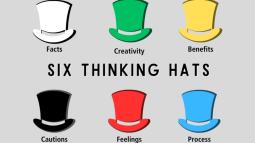
One of these strategies was the Six Hats strategy developed by the British doctor "Edward de Bono." In this article, we will learn about the six hats strategy and how it contributes to developing the student's thinking skills.
What is the Working Principle of the "Six Hats" Strategy?
Edward de Bono, the creator of this strategy, says: "It is an effective tool in changing the way the teacher and the learner think. It is based on a discussion that allows the individual to switch their thinking pattern into six patterns to solve the problem they face."
Gross said this strategy is "a system that enables an individual to think about one of the thinking trends represented by the colors of the six thinking hats."
This strategy is based on dividing thinking into six patterns and considering each of the hats as a pattern. Each hat has a color based on a specific type of thinking as the owner of each hat adopts a position that they desperately defend without hearing any of the owners of other opposing ideas and not allowing them to defend their ideas, as they are subject to the specific pattern at that moment.
This strategy is an effective tool for developing parallel thinking, innovation development, exploration, and initiative, a disciplined process aimed at streamlining the thinking process to reach the appropriate outcome.
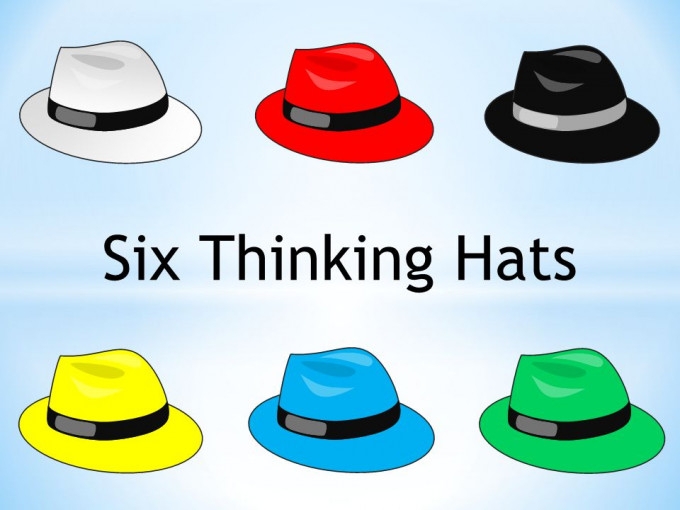
The Meanings and Colors of the Six Hats
The White Hat
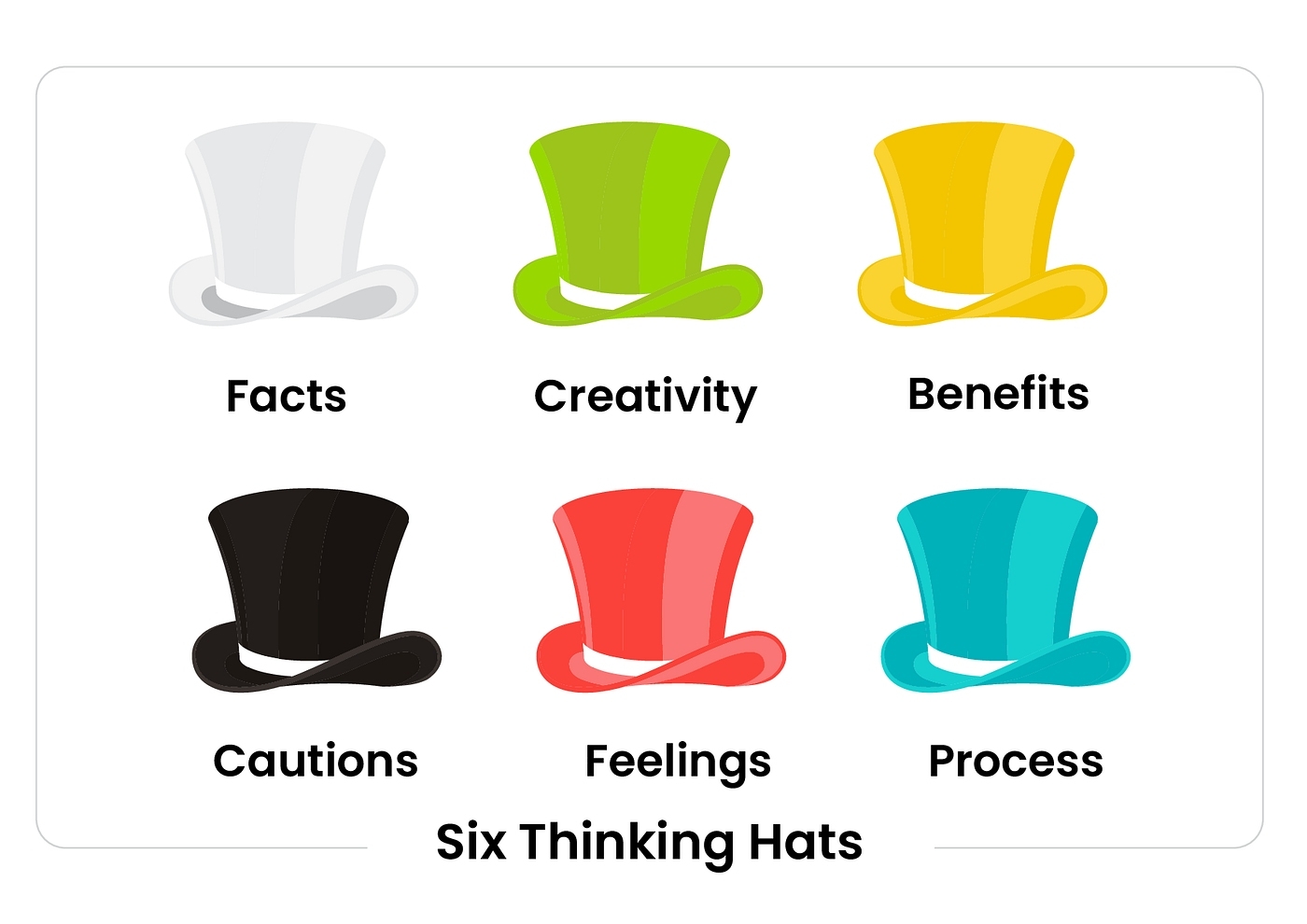
It refers to impartial and objective thinking. The white color of this pattern is chosen because it symbolizes serenity and purity. The individual wearing the hat searches for and collects information and does not criticize or repel any judgment.
Questions raised by the White Hat individuals are:
- What information do I have on the subject?
- What information should I be looking for?
- What is the missing information that I have to complete?
- What questions should I ask specifically?
Thinking in white has a set of characteristics, namely:
- Its presence is essential for all other species.
- It has no color, as it is characterized by objectivity and accuracy in research.
- Sharp-minded, it maintains its focus on all occasions and situations.
- Quiet and disciplined.
The Red Hat
It refers to emotional thinking. Red symbolizes love and emotions. The red-hat individual must express their thoughts emotionally and be full of feelings according to particular tendencies, tastes, sensations, and perceptions of beauty and other emotions without justifying those feelings.
The Red Hat individuals do several things, including:
- Focus on any subject in feelings and not in fact information.
- Reject truth and justification based on the use of emotion.
- A clear irrational bias to the human side in any situation.
The Yellow Hat
It refers to positive thinking. Yellow symbolizes the color of the sun and optimism. The thinking here ranges from two points of "logic and imagination" and focuses on strengthening existing strengths and how they can be used in new situations.
Questions raised by the individual with the Yellow Hat are:
- What features and strengths exist on this topic?
- How can I benefit from these strengths positively?
- Who benefits from these positive points?
- How can these positive points help me?
- How can these positive points be applied in new situations?
Most of the focus of the yellow hat is the feasibility and benefits we will get and how to modify the currently existing system so that we apply new ideas, focus on the available opportunities, increase the prospects of success, and reduce the possibilities of failure and fizzle out. The most important characteristic of its owner is the love of achievement and success.
The Black Hat
It refers to negative thinking, criticism, reservation, and pessimism. Its mission is to discover errors and warn against falling into danger, depending on justified reasons based on facts and information. It focuses on weaknesses and criticizes them for addressing them, and the reasons for lack of success and their negative aspects are explained.
Examples of questions raised by the Black Hat individuals:
- Where are the weaknesses in the subject?
- What is the impact of weaknesses?
- How can weaknesses be addressed?
The Green Hat
It refers to creative thinking, energy, and vitality and is based on proposing creative solutions to produce new and different ideas, which leads to the modification and development of ideas.
Questions raised by the Green Hat individuals include:
- What are the ways to make ideas come true?
- Which way to achieve new ideas is better?
Among the characteristics of the individual with the green hat are ambition, possessing critical thinking and reflective thinking, working to remove errors, and creating a variety of alternatives.
The Blue Hat
It refers to holistic thinking and overview. Blue symbolizes the color of the sky. It's all under the sky. It is a symbol of strength and leads thinking to the best results, as its mission is to guide and control the remaining five thinking patterns. It decides which pattern begins with thinking first and when it ends, and the role moves to another pattern.
There is not necessarily a regulated role for the hats; rather, the blue hat calls for any hat of them that is appropriate to the situation and focuses on conclusions, summaries, and decisions. The blue Hat wearers have the task of arranging, organizing, developing steps, conducting dialogue, and guiding the debate, thus bringing together and reframing views once and for all.
The questions raised by the Blue Hat individuals:
- What is the next step to take?
- How to implement the new idea?
- How to avoid the risks identified by the black hat?
- What are the ways to benefit from the suggestions of the yellow hat?
- How can the feelings suggested by the red hat be maintained?
Objectives of the Six Hats Strategy in Education
- Teaching the students how to express themselves, their emotions and feelings, and to communicate appropriately with others.
- Teaching the students' dialogue skills and the correct management of the discussion.
- Developing the students’ skills to understand and interpret the feelings and thoughts of others.
- Developing the student's ability to diversify their words, style, voice, and apparent features according to the case they are
- Help the students to form concepts.
- Increasing awareness of the types of thinking and making the students the focus of the educational process.
Characteristics of the Six Hats Strategy
- The six hats method allows students to express themselves according to six different thinking styles: "neutral, emotional, creative, positive, critical, cognitive."
- Defining roles makes thinking an organized and arranged process according to steps.
- The method is straightforward, easy to learn, and can be practiced until mastery.
- Allowing expressing
- Making education more useful by leaving the traditional methods and following them to get the best analysis of education.
- Separation of self and performance, for the wearer of the hat does not necessarily have to think of the hat; rather, they can play the role of the owner of a hat that contradicts their true opinion and make an effort to defend the idea of the hat, whatever it is.
- Generating many ideas of both negative and positive types.
- Emphasizing the accuracy and credibility of information and methods of processing it to make it completely clear.
- An integrated and comprehensive strategy that takes little time to implement and motivates students toward
- This strategy relies on role-playing in implementation, giving it a fun, comfortable atmosphere and benefits simultaneously.
- Developing brainstorming, problem-solving, and all critical thinking skills and encouraging It also emphasizes cooperation among all students and not unhealthy competition.
In Conclusion
Education is considered one of the highest human messages by which the universe is built. Keeping pace with the current cultural and cognitive development requires us to pay attention to the modernity of education and develop its curricula and methods of thinking. The result is the right decision.




Add comment