Using the Brainstorming Approach in Education
Societies today have become seriously interested in human education and development as the real source of wealth. Since humans are counted as a present and future investment, they are the basis and axis of all progress.
There is no doubt that the responsibility of preparing the thinker and creative person who can solve problems lies with the educational system in those societies, as education is an important tool of civilizational construction and an essential element of the decisive elements in the development of mankind.
It is an intentional and planned process that does not happen randomly, as it is carefully designed to prepare the emerging generations in a way that suits the requirements of the times. Today, the criterion for the progress of countries is measured by the development of the minds of their citizens.
Because the authorities responsible for education in different countries believe in the importance of that goal, a lot of educational research has been prepared, great efforts have been made, and a lot of money has been invested to identify methods and styles of teaching capable of making that person organized with his thinking and creative with his ideas.
Perhaps the best outcome of this research is to bring about a qualitative shift in education, to end the role of the passive learner and involve them in the educational scene, to help them collect and analyze ideas, to issue appropriate decisions and judgments, and to reach the correct conclusions.
To guide learners and assist them in being creative in problem-solving within a team, educators have developed a brainstorming approach specifically for this purpose. According to educational research, a group may generate in an hour what a single person needs days to produce. Collective thinking is also superior to individual thinking.
The conventional approaches to education focused on feeding information to the learners are reduced in the brainstorming approach to education, which occurs between the teacher and the learner or between a learner and another learner.
Brainstorming Approach
There are various names for the educational approach known as brainstorming, including generating ideas, mind-stimulating, creative thinking, and ideas flow. This approach encourages learners to come up with as many fresh ideas as they can without stopping to evaluate them as they arise- the evaluation is delayed until the end of the session.
Instead of generating fresh ideas, as is often the case, brainstorming aims to get learners used to working in groups and the value of contributing. Here, the main point is that an educator's idea can serve as a strong inspiration for the ideas of other learners, and the multitude of ideas is what creates a quality idea.
The inventor of the brainstorming technique, Alex Osborne, states that it is "an innovative conference of a special nature to produce a list of ideas that can be used as keys leading to collective ideas that are free from constraints and open to reality.
It is not constrained by pain, stiffness, or narrow-mindedness." In other words, it is a process of thought that is structured and organized. It happens when you use your creativity to develop as many ideas as possible to help solve the problem, brainstorming solutions from different perspectives.
Osborne first applied the method to his advertising company by holding business meetings for employees to boost his company's sales in 1938.

Many came after him who gave definitions of this approach, including:
- Son: It is one of the methods of social discussion by which members of the group are encouraged to generate as many diverse and innovative ideas as possible in a spontaneous and free manner and in an open, uncritical climate that does not limit the release of these ideas, which represent solutions to the problem and thus choose the right one.
- Jarwan: using the brain or mind to actively address the problem and mainly aims to generate a list of ideas that can lead to solving the problem.
- Majid Mahdi Muhammad: generating and producing creative ideas and opinions from individuals and groups to solve a specific problem; these ideas and opinions are useful. In other words, the individual is provided with a free environment that permits the emergence of all viewpoints and ideas by putting the mind in a state of thrill and readiness to think in all directions to generate the greatest number of ideas regarding the problem.
Advantages of the Brainstorming Approach
- It does not require much training and is easy to apply.
- It is inexpensive, and no specific tools or equipment are required; it just needs a suitable place, such as a classroom and a blackboard.
- Enhances the learner's self-confidence by offering ideas freely.
- Develops the ability to express oneself and ideas freely, as well as a platform for creativity and imagination.
- Activates the role of the learner in educational situations and ends their negative role.
- The learner gets used to listening to other learners, analyzing their ideas, and making the most of them.
- Helping to create a comfortable and collaborative classroom atmosphere while encouraging individual creativity and reducing inactivity within the classroom.
- Achieving education democracy and making the learner more self-aware.
- Brainstorming is a training process to stimulate imagination and creative thinking.
- Avoides criticism and leaves the evaluation process until the end of the session.
Rules Governing the Brainstorming Approach
No matter how basic or superficial they are, the learners' ideas should be allowed to be presented without interference. The educator who is leading the session is responsible for making sure learners don't withhold fresh ideas because they fear that they will be criticized. Anyone using criticism throughout the session should be warned to stop and take the initiative to offer their ideas.
1. Freedom of thought and encouraging ideas without any restrictions during the session:
All ideas generated during the session, regardless of their type or level, should be welcomed and encouraged. The aim is to make the learner less reserved about their ideas, in addition to encouraging them to be more efficient in employing them and their imaginative abilities under different circumstances.
2. The quantity of ideas is important, not their quality (quantity generates quality)
The session leader must focus on the task of generating and eliciting as many ideas as possible, regardless of their quality, weirdness, or even lack of logic. This is based on the principle that the greater the number of ideas, the greater the probability of having original solutions.
3. Building on other people's ideas
In these sessions, it is possible to start with the opinions and ideas of other individuals and come up with new ideas and solutions. The ideas presented here are not exclusive to anyone; rather, the aim of presenting them is to make the group benefit from them and build its ideas on them as if someone developed someone else's idea.
Steps of the Brainstorming Approach in Education
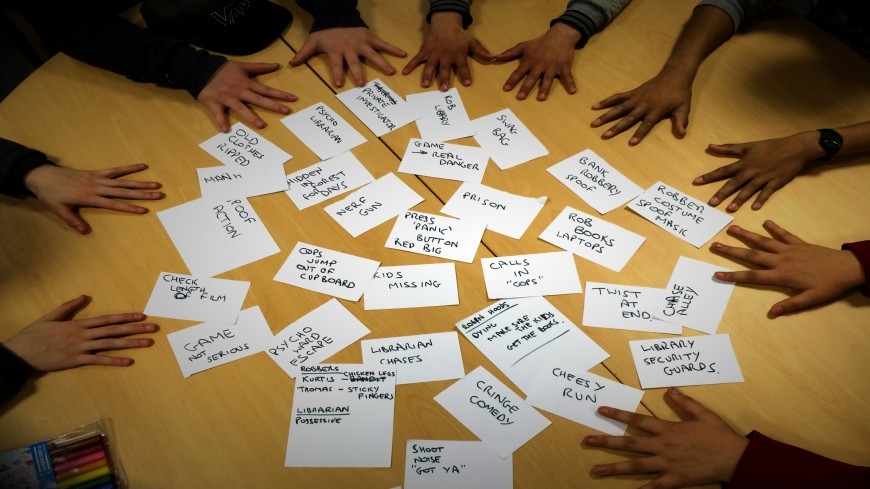
1. Determine the theme of the session
The problem statement must be defined so that its formulation is clear and specific. It must be broken down into its basic elements so that the next steps are clear.
2. Eliciting ideas
Here, ideas related to the topic under discussion must be generated, and it is not permissible to evoke unrelated ideas because they are a waste of time.
3. choose a solution
The best solution for the problem at hand is selected once these ideas have been assessed and what can be used from them has been selected.
Obstacles to Brainstorming:
- The learner's fear of others mockery when they present ideas that may seem ridiculous to them.
- The individual is restricted by the leader of the session, their colleagues, or even themselves, so that they cannot think freely or voice out their thoughts.
- Following and adhering to a pattern of thinking.
- A learner's lack of self-confidence and the assumption that they are unable to create or devise new solutions to any problem, as they may assume that they do not have the capabilities and talents to practice that process.
- Rushing to evaluate and judge ideas is fatal for new ideas. So you should always stay away from it.
- Criticism and uttering destructive and frustrating phrases by the leader of the session or the group towards the individual presenting the ideas, such as, “What guarantees the success of your idea?” “Your idea is outdated,” “Your idea is useless,” and so on.
In Conclusion
To sustain a good human life, we must know and practice with interest all modern educational methods. An educator must learn about the latest, most recent, and most useful educational approaches and use them effectively to broaden the learners’ understanding and thinking and transform them into independent learners while emphasizing the importance of integrating theoretical and practical education.
The brainstorming approach is one of the most common in the field of education, which is the production of creative ideas by individuals and groups to solve a particular problem in the sense of putting the brain in a state of readiness for reflection and providing an atmosphere of freedom to allow as many new opinions to emerge as possible, thus evaluating them and choosing the best solution.