Methods of Teaching Programming to Children and Its Benefits
The era of technology that entered the twenty-first century changed the order of priorities in educational systems.
Programming occupied the first place in capturing the attention of the masses of learners, as it is the hand that controls the process of creating new joints in life and because learning programming makes a positive and effective change in the details of our daily lives.
Childhood is the stage of pure mind and a blank page; therefore, the idea of teaching children programming has emerged as a successful investment for their eager minds in a field that provides great services to humanity. Therefore, we at Al-Najah Net have dedicated this article to talk about methods of teaching programming to children and its benefits.
Benefits of teaching programming to children
The benefits of teaching programming to children are endless, because these benefits will stem from two aspects: first, from the study of programming itself and the advantages it offers in life and the workplace; second, from educating children and investing their energy, abilities, and open minds.
The advantages of teaching youngsters programming can be summed up as follows:
1. Useful knowledge
Acquiring knowledge is one of the benefits of teaching programming to children. Children these days are constantly in contact with computers, smart devices, and technology. Therefore, introducing them to the working methods and mechanisms of the devices in their hands enhances their awareness of the things around them and helps them understand them.
Just as education is based on introducing children to what the things around them are, starting with their bodies and their components and vital processes, all the way to plants, animals, languages, and mathematics, the educational system must cover technical and programming concepts that explain how the devices and machines work that children deal with as an integral part of their surroundings.
Schools have begun to use computers and rely on them to carry out tests, activities, and jobs since the primary stage, and therefore teaching programming to children and helping them understand the language of computers and their applications has gone beyond the stage of luxury and has become an absolute necessity.
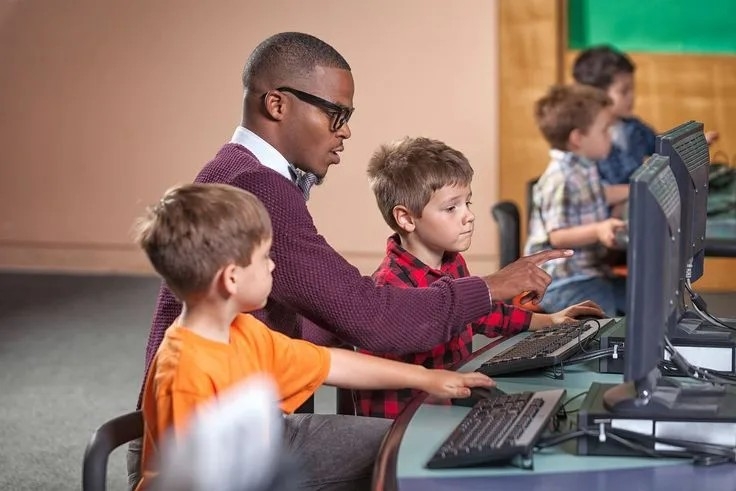
2. Developing computational thinking skills
One of the benefits of teaching programming to children is that it develops the skill of computational thinking in their brains and teaches them how to make a logical, sequential connection between ideas and stages through their learning of algorithms.
They learn to draw scenarios and alternative plans for each of the possibilities during the planning process that precedes the formulation of the idea in the form of software code. This skill is reflected in life matters, so that children are able to deal with their problems and think about them logically and strategically.
Teaching children programming helps them understand how to break down a large problem or task into smaller tasks, which facilitates the process of implementation and application.
3. Troubleshooting
One of the benefits of teaching programming to children is that it develops their power of observation. The code cannot work perfectly if it contains one error, no matter how simple it is. One comma or a typo in one of the letters are enough reasons for the code not to work or to work in an unplanned way. In this case, the young programmer is forced to search for the bug that caused this error, and they use all their attention in this search.
Some of these errors cannot be detected at first sight. This helps the child develop the skill of searching for the error, discovering it, and learning from it in the coming times. In the midst of this research, we do not forget the skill of patience that they will acquire, the skill of rejecting failure, and the continuous research and experimentation until the code works as intended.
4. Strengthening the child's self-confidence
The confidence the child gains in themselves and their abilities is one of the most important and greatest benefits of teaching programming to children. If a child who works on a specific programming code puts all their effort and focus into it and searches for mistakes until it finally works as they want, then their self-esteem will rise, and they will feel in control of things.
In addition, they will feel that they have an important and great role, and we can imagine the impact of the joy of feeling accomplished on the child's personality in life, their independence, and their entitlement.
5. Job opportunities in the future
There is no doubt that one of the benefits of teaching programming to children is employing their skills in learning a field that will be a source of livelihood for them in the future. The introduction of technology in all aspects of daily life has led to a constant need for programmers.
Even if the individual does not want to work as a programmer who designs programs and codes, they will get from learning programming the experience and skills in dealing with computers, machines, and applications, which adds to their acceptance of the jobs they are applying for and facilitates the process of obtaining a job opportunity.
There is no doubt that the programming profession is one of the highest-paid professions these days. Therefore, a child who learns programming from a young age will have mastered many programming languages and have invaluable experience, which makes working with them profitable for the companies, and tempting employment contracts will fall on them.
The importance of teaching programming to children
There is no doubt about the importance of teaching programming to children, as it improves their skills, enhances their abilities, and develops the way they interact with the world.
Here are some points that explain the importance of teaching programming to children:
- Teaching programming to children develops their mental abilities. Programming languages are information languages like other languages. Children learn them, so the flexibility of their brain cells increases, and their comprehension and memorization skills develop.
- Satisfying the child's curiosity and providing answers to many questions in their mind. This feature is golden in explaining the importance of teaching programming to children. Children have many questions about the work of devices and machines, and learning programming will provide them with convincing and satisfactory answers.
- We do not forget the aspect of entertainment and enjoyment that reflects the importance of teaching programming to children. Inventing, applying, and operating a child's electronic game is an enjoyable and useful activity for them, in addition to stimulating their creative abilities.
- The importance of teaching programming to children lies in developing their problem-solving skills. When a code fails, the child will search for the source of the error, work to fix it, and transfer this skill to their life situations.
- In addition, accustoming the child to perseverance explains the importance of teaching programming to children, since children are usually quickly bored, so learning programming helps them get used to patience, perseverance, and persistence.

Methods of teaching programming to children
There are many ways to teach programming to children, and they are integrated as a whole because they all serve the same purpose. It is possible to start with an introduction to the child on the subject of programming languages and their functions, and then move on to learning and application according to what aroused the child’s curiosity and attracted their attention.
Here are some ways to teach programming to children:
1. Introduce the child to programming languages
Introducing a child to programming languages is the first method of teaching programming to children, and this introduction must be simplified to sentences they understand. For example, we tell them that programming is telling the computer what we want to do, mention some ways to tell the computer what we want, and name programming languages whose use varies according to their purpose.
2. Using programming languages that help the child understand the types of programming
Employing different programming languages in the learning process is one of the methods of teaching programming to children. Children can be introduced to the following languages:
- Scratch: It is a programming language inspired by the game of cubes, in which each cube carries a set of commands that the child drags and arranges to build games and characters.
- Java: It is one of the most popular programming languages. It is the programming language used in designing the famous game Minecraft, and a child can use it to create and add modifications to the game.
- JavaScript: It is used in programming web applications, interactive games, and websites.
3. Encouraging the child to take interest in programming
The teacher’s encouragement is one of the methods of teaching programming to children. The teacher can participate with the child in learning programming. This is done by watching educational clips of the programming language to be learned on YouTube together, attending online courses and applying information in a competitive manner, or constantly motivating the child to learn programming by enumerating the advantages and benefits that they will receive when learning programming.
4. Employing applications in the learning process
This step is one of the most enjoyable ways to teach programming to children because they tend to experiment on their own more than with traditional learning and explanation. Several apps are available on app stores that help teach programming to children in simple, easy, and entertaining ways, and we mention among these applications:
Code Monkey
This application is one of the best ways to teach programming to children in a fun way because of its bright colors and attractive characters. It is suitable for children aged 4-6 years old. It enables them to learn the basics of programming in an easy and fun way, even if they have not learned to read yet.
Tommy the Turtle - Learn to Code
It is an application based on visual learning for programming using games and voice command challenges accompanied by Tommy the turtle. By passing each stage, the application takes the child to a higher stage.
SpriteBox Coding
It is an application that uses Java to teach children programming. It aims to teach children parameters, sequences, and building basic Java sentences in an easy, fun, and attractive way.
How do we start teaching programming to children?
We start teaching programming to children by preparing them psychologically to embark on this learning journey, talking to them about the benefits and importance of learning programming and its role in developing and facilitating life, thus reinforcing their motivation towards the learning process, and then preparing the computer that will be the implementation tool in the process of teaching programming to children. The computer must have the following specifications:
- Intel Core i5 processor, or equivalent from an AMD company as a minimum.
- 8 GB of RAM.
- SSD Storage.
After securing the required computer, they start attending programming courses for children on YouTube or other educational platforms, free or paid.