



This child inevitably lacks the art of time management. Some people may think that children are too young to realize how to manage time themselves and are too weak to be able to control their desire to end playtime or use smart devices.
But it is all related to training to master it, just as they have learned to eat alone and go to school without hiring anyone. If you are an educator looking to teach your child the principles of time management and management between serious and fun times, please read this article.
How to teach my child the art of time management?
To the mother who believes in the value of time and is aware of the importance of organizing and managing it and wants to transfer this feature to her child, here are the tips that make your task easier:
1. Start at an early age
Every mother asks, “When do I teach a child the art of time management?” When looking for the perfect time to start, we answer "Start now" no matter how old your child is. The time is appropriate to teach them time management, and the younger your child is, the better. Specialists point to the need to establish a consistent routine for infants from their first days, which takes the task of introducing them to time.
For example, in the morning, they are advised to open windows and curtains to bring the sun into the room to mark the start of the day and its vital activities of eating breakfast, playing, and other. In the evening, this is by following a routine that begins with dinner, bathing, reading the story, and then sleeping, stressing the need to start this routine at a specific time. Even if the sun has not yet disappeared, you must close the curtains and turn on a light indicating bedtime.
As for the period between the morning and evening routines, be sure to eat lunch and snacks at specific times, as this helps to adjust the child's biological clock and get used to managing time and organizing their day.

2. Make a day plan
We continue to answer your question, “How to teach the child the art of time management?” With the advice of making a plan for the tasks that must be carried out during the day, after waking up, going to the bathroom, changing clothes, and eating breakfast, agree with your child on the tasks that you will do during the day, and if your child can do some work on their own, do not hesitate to tell them that.
For example, you go to the supermarket and buy things together, and then you prepare lunch while they clean the garden, or you perform household tasks while they read a story to drink together a glass of juice immediately after completing your duties.
Do not make the planner full of tasks. Rather, leave them free time to spend as they please, and include the times of watching TV or using smart devices on your planner, as this motivates them to complete the routine and adhere to it, and then they learn the art of time management.
3. Add some fun to the routine
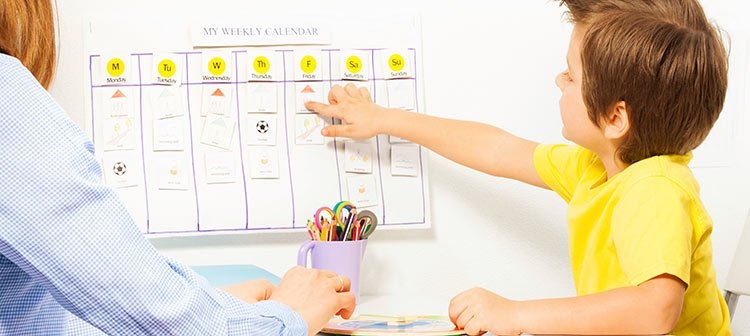
To teach the child the art of time management, you must make this fun and loving, such as drawing a schedule of tasks or writing it according to the age of the child and allowing the child to put a sign (✔) on the missions they completed and did because this increases their desire to adhere to the system and the time set for each task.
One pedagogist stated on her Instagram page about the magical method that transformed the morning period before her children went to school from a period of tension, urgency, and screaming to a flexible and quiet period. The tool used was a table of its design that contains drawings indicating the tasks that each child must do during a specific time during the hour that falls between the time they wake up and the time they start school. She allocated time to enter the bathroom, change clothes, make the bed, and eat, and painted along with each activity the shape of the clock with her hands at the moment it started.
This is useful in teaching the child to commit to the time and manage it by allocating a specific time for each task that begins at a determined moment and ends with the start of the next mission. If the child finishes on time, draw a signal indicating this and feel the pleasure of the time competition and the joy of achievement.
One of the means that adds fun to the process of teaching the child the art of time management is to set the timer for a short period and enter into a race against time to accomplish a specific task and celebrate if it is fulfilled before the sound of the alarm clock, and provide a reward to the child for their speed in completing the task.

4. Teach your children how to measure time
While talking about teaching the child the art of time management, you must accustom them to the example of using time and clockwise terms at certain times. If you are a working mother, for example, and you leave the house at seven o'clock, point to the clock at that time and tell them that it is the seventh and it is time for you to go. If their father returns from work at a specific time, let it be the fifth, for example, tell them that this is the form of the fifth hour, and at such a time, their father returns from his work. You can buy a watch for the child to link the performance of the task to a specific time after they get used to measuring time by the hour.
One of the methods also used in teaching the child how to measure time is to use terms that indicate the duration of time, such as saying to them we will boil eggs for ten minutes, we will watch TV for half an hour, and we will wait one minute. So, the child learns to use the duration of time in their speech and lifestyle.
5. Talk to the child about the importance of time management
It is impossible to force a child to do something and wait for a good response from it. Children respond with persuasion much more than coercion and imposition, so if you want to teach your child the art of time management, you must talk to them about the benefits of organizing time and performing tasks on time.
When your child returns from school and gives them a half-hour break after lunch, for example, before they start studying, you should point out to them the importance of this break, as it makes them rest a little tired of the school day and prepares them to start the study process. If they try to procrastinate in it, tell them that this interest may fade if they prolong the play period more and will lose the ability to concentrate on their lessons, as their body has become exhausted from play, as well as from bedtime, waking time and iPad use time, so make sure that your child participates with you in setting their own schedule, and adjust this schedule to suit their own nature.
6. Have some flexibility, which is really necessary
We teach the child the art of time management to be comfortable and happy, not for time to be a ghost chasing them.
Flexibility, exceptional situations, and breaking the rules are sometimes okay. For example, if your child's bedtime is at eight o'clock and you have gone to sleep in the family home, and all the children of their relatives are their age will watch a movie or read stories at this time, do we miss the child the pleasure of these meetings under the pretext of adhering to routine? Likewise, for holidays or trips and others, some flexibility will make the routine a safe haven that the child prefers to return to and increase their appreciation of the value of time and master the art of managing it.
7. Set a good example
Surely, your child will not learn the art of time management if they see you behaving otherwise, such as oversleeping in the morning, making lunch at distant times, or doing what you forbid. Children learn by example what is challenging to learn by guidance and indoctrination.
So, if you want to teach your child the art of time management, be a good role model. Allocate time for your homework and another for your family, and a specific time for yourself. You only watch a movie or drink something you love and meditate with quiet music to recharge your energy to perform the next day's tasks so that children learn from you to manage time first and raise their entitlement and self-esteem second.
8. Let your children experience the loss of time by themselves
If your child is of the stubborn type and only responds to some of your advice and plans related to teaching them the art of time management, let them try to flow time between their fingers. If your child's bedtime is at eight o'clock and they still have schoolwork to write, be strict and apologize to them, telling them this is bedtime and that the time for writing schoolwork is over, and call the teacher without their knowledge and let them experience themselves embarrassment the next day and realize the consequences of the subject.
It is often a lesson for them to commit to performing their tasks on time, and with such behavior, you teach the child the art of time management and stay away from procrastination, and depend on themselves, as you did not solve the duty or change the laws for them.
In conclusion
Time management art is a skill that is needed by large and small nowadays and in this accelerated world. Therefore, it is necessary to take care to acquire it because it contributes significantly to facilitating life and accustoming man to commitment and responsibility. Because knowledge in childhood is like engraving in stone, we were keen to provide you in this article tips teaching the child the time management art through these simple tips supported by examples, and we hope that they will be helpful in this journey.




Add comment