



However, this form of documentation can soon become overwhelming, lacking clarity and making it difficult to gain a comprehensive understanding of the subject or identify missing elements at a glance.
Instead, take a look at some examples of mind maps to learn how to create and visualize your ideas.
Mind maps offer a holistic view of the hierarchical flow of ideas and their interconnections. They can unveil connections you might have overlooked and provide fresh approaches to brainstorming. In the following, we provide additional information on mind maps along with examples to inspire you the next time you need to organize your information.
What Is A Mind Map?
A mind map is a simple radial diagram invented by Tony Buzan. It serves as an effective tool for organizing sub-ideas associated with a central concept. This technique proves especially beneficial when you need to structure your thoughts, elaborate on an idea or project (like a new product or service), address a problem, and more. By documenting your thoughts, you open up space for additional ideas.
This article will focus on the basics, which involve creating mind maps using pen and paper.
Creating a mind map is to visualize all your ideas clearly. Therefore, don't make it complex by using too many colors or shapes that may cause distraction. Use different colors purposefully, keeping the mind map simple and easily traceable.
How To Craft A Mind Map?
By following the three steps below, you will be able to create mind maps easily and quickly.
- Choose a central topic.
- Draw branches for sub-ideas related to the central topic.
- Add points related to the sub-ideas on additional branches stemming from them.
Let's now take a look at an example that illustrates the benefits of creating a mind map using the previous steps.
1. Choose A Central Topic
Jot down on a blank piece of paper the subject that's on your mind—whether it's a problem you want to solve, a decision you need to make, an idea you want to develop, or a project you'd like to clarify.
Craft it with clarity and brevity. It could be a single word or even a key image.

2. Draw Branches For Sub-Ideas Related To The Central Topic
What is the first idea that comes to your mind when you think about the topic addressed in the mind map? Draw a line—straight or curved—from the main topic and note down that idea.

3. Add Points Related To The Sub-Ideas On Additional Branches Stemming From Them
What prompts you to think about that idea? What thoughts are linked to it? Include them close to the sub-idea by connecting them with short lines or using a different color, ensuring that it remains organized.
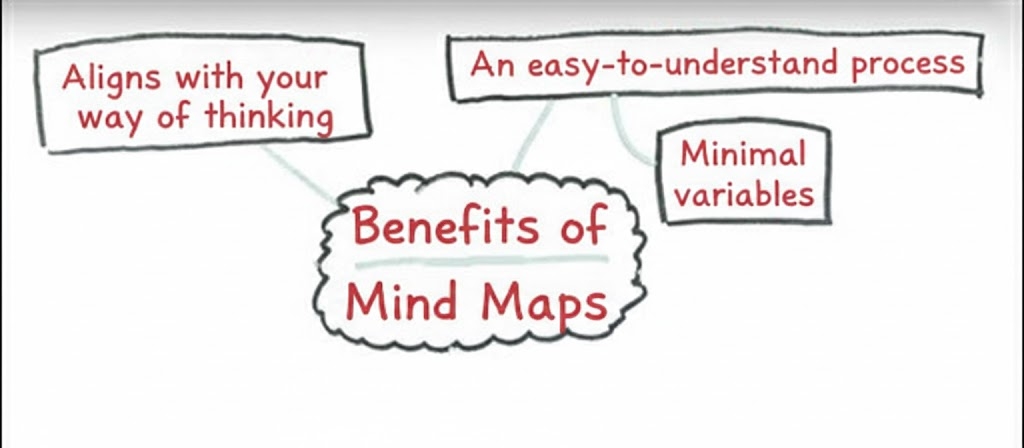
You can add images or additional branches later, but for now, this serves the purpose.
We can add details to the secondary branches, such as "benefits," by introducing them in secondary branches emerging from it. However, due to space constraints, we can't demonstrate it here. You can draw a line in an empty area on the page and include them, but it may appear a bit unconventional.
As we've created this mind map on a regular sheet of paper, the limited space constrains the amount of information it can accommodate. This is one of the primary reasons we recommend using software rather than pen and paper for most of your mind maps.
4. Repeat Steps Two And Three
Repeat steps two and three as much as needed to capture all your thoughts on the chosen topic.
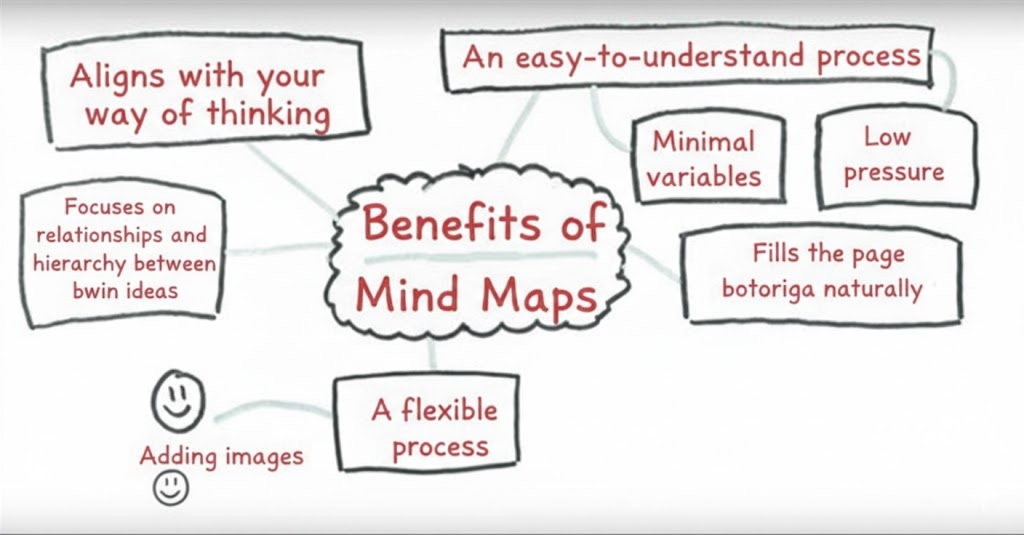
We added main branches around the central topic clockwise, from the upper right to the upper left; this is the way the mind map is read.
Strategies For Creating Mind Maps
Now, let's explore three strategies for crafting your mind maps and illustrate them with examples:
1. Gradual Branching
This method entails sequentially adding complete branches (along with all their secondary branches). Begin by jotting down the main topic, then introduce the first branch. Concentrate on this initial branch and expand it by including as many details as desired—incorporating all the sub-ideas that come to mind.

Afterwards, develop the ideas one by one.

Your mind map will be complete once you've filled in your ideas within the branches.

2. Gradual Levels
This approach entails incorporating elements into the map by introducing one level at a time. This means adding all the ideas related to the main topic (i.e., the primary branches) first and then incorporating the secondary branches for those main branches. You begin by adding elements at the first level:

After that, move on to each main branch, then add the direct secondary branches (on one level only), forming the second level:

Repeat the same steps when adding the third level. You can include as many levels as you wish in the mind map. In our example, we have three levels, and the map is now complete:

3. Free Flowing
The Free Flowing strategy allows you to spontaneously add elements to your mind map without adhering to a specific order. There are no rigid rules governing the flow of ideas, but it's crucial to exercise discernment in deciding whether an idea should be a main topic or a subtopic.

Try each strategy, or a combination of strategies, and find what works best for you to help you start solving problems.
In Conclusion
When your thoughts feel blocked or a particular idea or project takes hold of your mind, grab a sheet of paper and start brainstorming and creating a mind map using our provided examples. Mind maps can help you clear your mind and organize your thoughts.
Never let a lack of pen and paper hinder your mind-mapping journey. Utilizing mind mapping software offers a versatile and effective alternative. You can seamlessly apply the same techniques and strategies mentioned earlier when working with mind-mapping tools on your phone or computer.




Add comment