


Note: This article is from Thanh Pham, founder of Asian Efficiency, who shares his experience discovering purpose in life.
If you've been reading the “Asian Efficiency” blog for a while, you'll know that we talk a lot about goals, results, and measuring actions.
All of this essentially means concentrating on having a life purpose. Purpose filters your actions, behaviors, and goals, telling you when to and when not to take action to do productive things about them.
Before we begin, there are a few things to keep in mind:
- We make no guarantees that your goal will be realized once it has been discovered. You may discover that your life's purpose is not to earn a living. Of course, in an ideal world, we would discover goals that others would value as well.
- Language is a barrier when it comes to big ideas like life goals, but go ahead and give it a shot.
- We will approach the goal from various perspectives. This is because our lives are complicated as real human beings; we are not heroes with a single cause like in Hollywood movies.
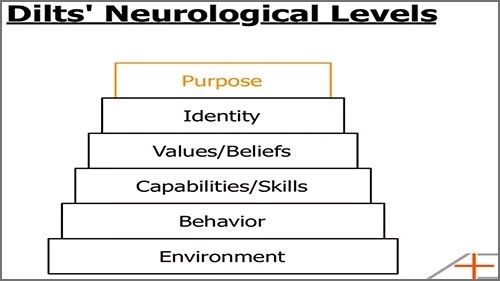
Dilt Neurological Levels
The above is a model of NLP called Dilts' Neurological Levels. A lot of neuro-linguistic programs are good ideas that are imaginative and purposeful, but there are elements of them that undoubtedly work when it comes to transforming our performance and our lives. The aforementioned model is one of these parts, and it is very appropriate to discuss the objective here.
Your life is run by your purpose, which is at the top. Your identity, sense of self, and who you are make up the first level. You might go by many different names, like "dad," "sister," "banker," or "marathon runner."
Your values and beliefs, which are the unwritten laws that direct your decisions, deeds, and behaviors, are situated beneath this level. They serve as immediate guides for choosing between difficult options in life. After that, there are abilities, which is another word for "ability" or "skill." Here is where you define your limits.
The environment and behaviors are the bottom two levels. The things we do are called behaviors. The things and occasions that surround us are our environments.
This model's ability to clearly distinguish between work, identity, purpose, and all the other levels is one of its most interesting features. For example, engaging in a behavior that society considers "bad" does not automatically transform you into a bad person; these are two different levels. The same is true for your daily activities, behaviors, skills, roles you play, identities, and purposes, all of which may differ slightly from those of others.
Five Questions to Discover Your Purpose in Life
To find your purpose, you should ask yourself the following five crucial questions:
- What would you choose to do if there were no restrictions or consequences in your life?
- Up until now, what has been a recurrent theme in your life?
- What special value do you believe you can offer the world and all of humanity?
- Story Power Test: What makes you cross a wooden bridge between the Petronas Twin Towers in Kuala Lumpur?
- What will Wikipedia say about you when you pass away and have fulfilled all of your goals?
Let's dive into these questions:
1. What would you choose to do if there were no restrictions or consequences in your life?
This is the most common question asked when it comes to setting goals. But it goes beyond that. This question is very useful for determining what you truly want out of life.
It emphasizes no conditions, no consequences, and consequently no judgment, which is wonderful. Each of us possesses a dark side, and this question offers the chance to let it rush in, radiate out, and enlist our most intense and difficult desires.
This is because, despite the fact that we may try to suppress or hide them, our dark sides are actually an integral part of who we are and why we are here.
This question also dispels any idealization we might have regarding our purpose for being here. The reply to this particular question speaks to the enjoyment of life.

2. Up until now, what has been a recurrent theme in your life?
Our past actions have shaped who we are and, to some extent, explain why we are where we are right now. One way to discover what we are innately drawn to and what patterns we frequently repeat in our lives is to inquire about the main theme of our past.
The next question would be, "Would you change this theme or idea?" It doesn't follow that something should continue just because it was once a part of us.
It is important to recognize that the majority of our previous lives were the result of abusive influences from our parents, society, and school. We did not choose what we learned at the time, but we do have the option to move on.
This does not imply that everything we were taught arbitrarily was bad. Some of what we learned in the past was undoubtedly valuable, but now we must decide what to keep and what to redefine.
3. What special value do you believe you can offer the world and all of humanity?
This is the "soft side" of the goal. The part that speaks to the idealist in all of us. It's the giving side, the idealistic side, the "there is something greater than me" side of purpose.
You can begin with anything small and manageable or large and ambitious. It might simply be to provide something for your small family, such as your parents, siblings, or community.
It might be a contribution to your religion, your country, or all of humanity. Consider your abilities, skills, and areas of strength when answering this question.
4. Story Power Test: What makes you cross a wooden bridge between the Petronas Twin Towers in Kuala Lumpur?
This question is derived from the outstanding review of the book The Power of Story by author Jim Loehr. He claims that whatever it is that would inspire you to walk across a terrifying bridge, such as this one between these two towers, on a single wooden plank, is your life's purpose because the purpose is what gives you the drive and fortitude to accomplish the impossible.
We like to think of this as a "life threatening scenario" that makes things clear and aids in your decision-making regarding what is truly at risk in exchange for your life. This could be anything; don't restrict yourself to a moral standpoint here, and don't worry if it conflicts with some of your previous responses.
In fact, nothing less than saving your life will motivate you to cross this dangerous wooden bridge, and that's totally fine.
5. What will Wikipedia say about you when you pass away and have fulfilled all of your goals?
This is our modernised version of the typical "eulogy test" that self-help professionals like to spread. “What would you like to have included in your life history?” is another way to phrase this question. Our ego, which is a crucial component of our personality, is satisfied by this particular question.
The important thing to keep in mind is that Wikipedia is neutral and objective. The only way to guarantee that it says what you want is to truly live your specific purpose in life, as both the good and the bad in your life will be mentioned here.
In conclusion
If you answered all five questions correctly, you may have learned something about yourself and why you are here. The following step is to summarize your five responses. Simplify the main point in a sentence or two that describes your goal. You can and should make it look as good or as bad as you want; the choice is entirely yours.
Once you have this, you can use it as a lens to see if each action you take is moving you closer or further away from your goal and if what you are doing now is useful in achieving your goal. Remember that deviating from the path is sometimes necessary in life, but don't stray too far from it.




Add comment